



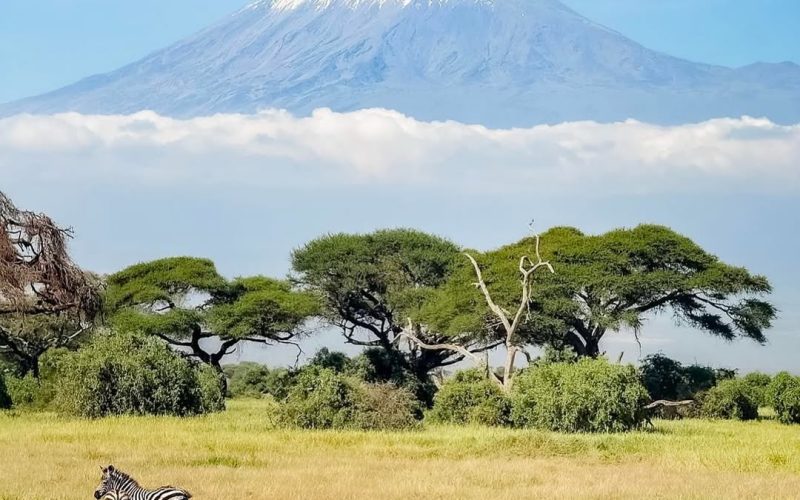
KILIMANJARO, TANZANIA. Towering above the clouds at 5,895 meters, Mount Kilimanjaro is not just Africa’s tallest mountain—it’s a geological marvel, a biodiversity hotspot, and a cultural icon. Known as the “Roof of Africa,” this dormant stratovolcano draws over 50,000 climbers each year from around the world. But beyond its snowcapped summit and world-famous treks, Kilimanjaro holds remarkable secrets that even seasoned adventurers might not know.
1. The Highest Freestanding Mountain—With a Twist
Kilimanjaro is celebrated as the tallest freestanding mountain on Earth, meaning it rises in isolation, unaided by a surrounding mountain range. But this title comes with a caveat: when measured from base to summit, Hawaii’s Mauna Kea, mostly hidden beneath the ocean, is technically taller.

2. Closer to the Stars Than Everest
Due to the Earth’s equatorial bulge, Kilimanjaro’s summit is actually farther from the planet’s core than Mount Everest’s. That makes it one of the closest points on Earth to outer space—even if it’s not the absolute highest above sea level.
3. Record-Breaking Ascent
In a feat of endurance and altitude adaptation, Karl Egloff summited Kilimanjaro in just under 5 hours in 2014—an astonishing contrast to the average 6-day trek.
4. A Journey Through Climate Zones
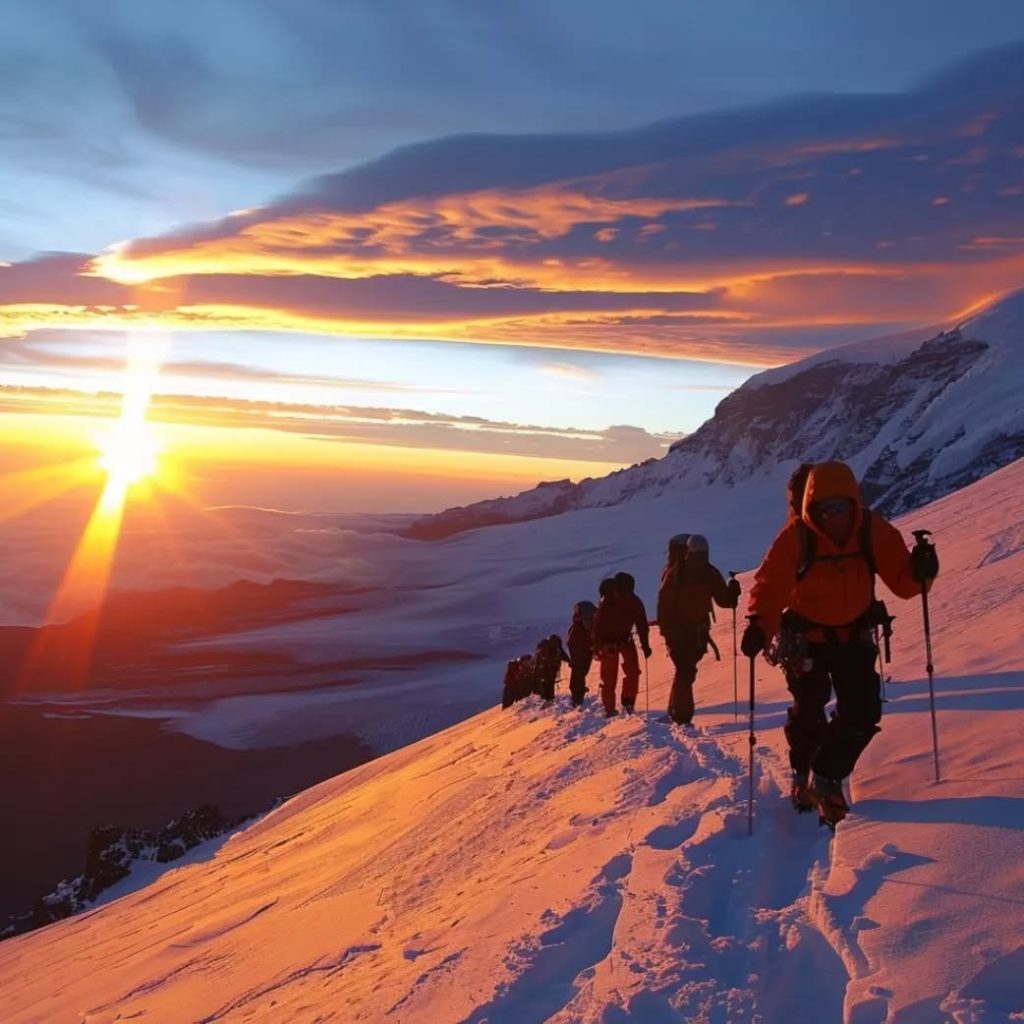
Kilimanjaro is like a vertical expedition through Earth’s ecosystems. Climbers start in humid rainforest, traverse alpine deserts, and finish in an arctic zone. The journey spans five distinct climatic regions, offering an unmatched ecological adventure.
5. Glaciers on Borrowed Time
Kilimanjaro’s iconic ice caps are vanishing. Once covering 12 square kilometers in the early 1900s, they’ve shrunk to under 2 square kilometers. Scientists warn they may disappear entirely by 2050 due to global warming and local deforestation.
6. Africa’s Tallest Tree Grows on Kilimanjaro
In 2016, scientists discovered the continent’s tallest tree on Kilimanjaro’s southern slopes. The Entandrophragma excelsum tree stands at a towering 81.5 meters (267 feet), making it taller than most skyscrapers.
7. The Candelabra-Like Kilimanjaro Groundsel
Unique to the mountain, the Dendrosenecio kilimanjari—also known as the Kilimanjaro Groundsel—thrives in high altitudes with succulent-like adaptations and insulating leaf layers. These alien-looking plants live up to 200 years.
8. Home to Endemic Life
From the vibrant Kilimanjaro White-eye bird to the elusive Abbott’s Duiker, this UNESCO-listed park shelters species found nowhere else on Earth. Some, like the Strongylopus kilimanjaro frog, haven’t been seen in decades, adding to the mountain’s mystique.
9. A Somber Chapter in History
In 1955, tragedy struck when a DC-3 aircraft crashed into the mountain during poor weather, claiming 20 lives. The wreckage still rests on Mawenzi’s slopes, largely undisturbed due to the site’s remote and rugged terrain.
10. “Rising Like Olympus”… Not Quite
Popularized by Toto’s hit song Africa, the lyric “Kilimanjaro rises like Olympus above the Serengeti” is more poetic than geographic. The Serengeti is over 230 kilometers away—and Kilimanjaro isn’t visible from there.
11. A Sleeping Giant
Kilimanjaro is not extinct. Its Kibo cone remains dormant, with scientists recording underground temperatures reaching up to 600°C. Though an eruption is unlikely, deep geothermal activity continues beneath its surface.
12. Foot tall at 5,714 Meters
In 2017, a women’s football match held in Kilimanjaro’s crater set a Guinness World Record for the highest-altitude game. Battling altitude sickness and freezing temperatures, players completed two full halves at nearly 6,000 meters.
13. Over 60,000 Climbers Each Year
First summited by Hans Meyer and Ludwig Purtscheller in 1889, Kilimanjaro is now one of the world’s most popular trekking destinations. Today’s climbers follow routes once pioneered by explorers and guided by forgotten African heroes like Muini Amani.
14. From Kaiser Wilhelm to Uhuru Peak
Before Tanzanian independence, Kilimanjaro’s summit bore a colonial name: Kaiser Wilhelm Peak. In 1962, it was renamed Uhuru Peak, meaning “freedom” in Swahili. Other camp names were changed to honor local leaders and erase colonial legacies.
15. The Name “Kilimanjaro” Remains a Mystery
Does it mean “Shining Mountain”? “White Hill”? Or “Source of Water”? Linguists and historians still debate the origins of the name Kilimanjaro, drawn from Swahili, Maasai, and local dialects.
16. Kenya Has the View, Tanzania Has the Climb
While most iconic photos are taken from Kenya’s Amboseli National Park, the actual climbing routes begin in Tanzania. If you want to stand on Uhuru Peak, there’s only one gateway: the Tanzanian side of the mountain.